M & D Moir

9 February 10  rene lalique glass  
 Home
rene lalique glass #01

Art Nouveau glass & Art Deco glass from Mike & Debby Moir

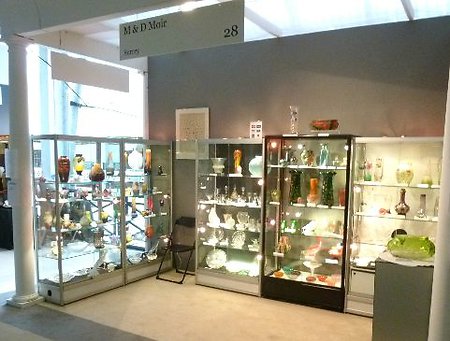
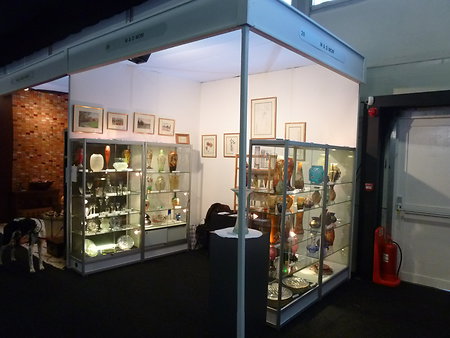
We specialise in selling art nouveau glass and art deco glass by Rene Lalique, Emile Galle, Daum, Schneider, Legras, Marcel Goupy, Moser, Loetz, Kralik, Rindskopf, Monart, WMF Ikora, L C Tiffany, and other great makers of glass between 1875 and 1955.


art nouveau glass #02

What's New This Week?

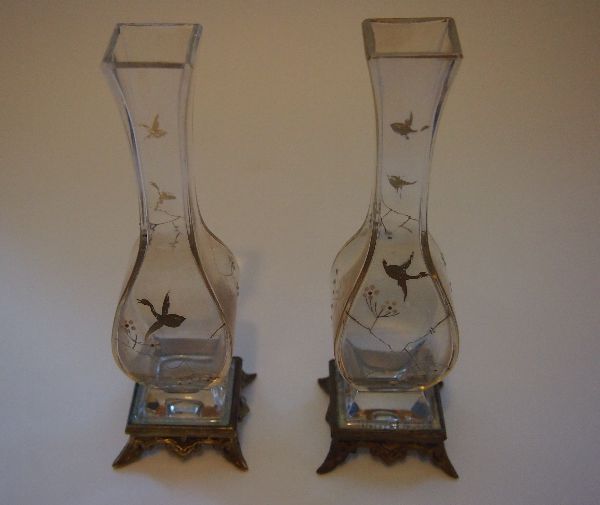
Week commencing 8th February 2010. So far this week we have added a very nice enamelled vase to the Loetz page and a stunning scent bottle to the Moser page. We have also added many new items to both our websites recently and we have some very special items coming soon -so please keep looking!

Non-UK visitors: the UK Pound is still quite weak at the moment. Don't miss the opportunity to take advantage of the really great exchange rates.

To go to our pages on the three great masters of French glass; Rene Lalique Glass, Emile Galle Cameo and Daum please CLICK HERE.

For all other great glass makers of the Art Deco and Art Nouveau periods please use the menu to the top left.


art deco glass #03

Updates to the Website

There are well over 250 pictured Art Nouveau glass & Art Deco glass items for sale on this website and its partner site www.ReneLaliqueGlass.com. These are live sites, new items are added EVERY week, usually by late (UK time) on Monday.

We have two websites; all our Rene Lalique, Emile Galle Cameo can be found here CLICK HERE. This website www.ReneLaliqueGlass.com has a page for special features, eight pages for Rene Lalique glass -each dedicated to a particular type of is production e.g. Bowls and Chargers. There are also two pages of Emile Galle Cameo and two of Daum Nancy Glass.


rene lalique glass #04

About Us

All our Art Nouveau glass & Art Deco glass pieces are original, i.e. to the best of our knowledge made at the factory of the named maker on or close to the dates given. We do not sell any reproductions, fakes or modern glass. Unless otherwise stated all our pieces are perfect, without visible chips, cracks or other defects. As most of our items are around 75 years old there are usually wear marks and minor scratches. We are happy to provide any prospective buyers with further photos and detailed description reports if required.

We are UK based, but we sell worldwide. We have been dealing in glass for over 12 years. You can buy items from us directly by E-Mailing us: Info@MandDMoir.com or Info@ReneLaliqueGlass.com or phone or text us on: 07843 022591 (inside UK) or +447843 022591 (outside UK) or by finding us at one of the many UK fairs we do. To see our list of forthcoming fairs, go to the 'Where you can see us' page. We are also regularly published in specialist antiques and collectors magazines in the UK. Look out for current articles in 'Collect it!' -on Galle and the 'Glass Cone' on Daum.

The prices shown on this website are identical to the prices we display on the items at fairs. As is usual with an antiques business the price you actually pay will be 10-15% less than that, plus, if required, postage (including insurance) -which we charge at actual cost. When you enquire about an item we need to know; how you are paying for the item and how we will get it to you, before we can give you a final price. Within the UK this price is usually coniderably less than the listed price and, for the rest of the world, it is still usually a little less than the listed price. If you are in any doubt please just ask.

We always try to respond to serious enquiries within 48 hours, but sometimes incompatible email systems mean your email may not get through or our reply may get blocked by you spam filter. If you email us and have not heard back within two days PLEASE phone or text us and we'll get right back to you.

This website now has two addresses; www.MandDMoir.com and www.MandDMoir.co.uk. and our email address is Info@MandDMoir.com, replies will come from MandDMoir@aol.com. You may need to make sure your spam blocker does not block our replies.

If you enjoy what's here please remember to put us on your favourites and please tell you friends about us!


art nouveau glass #05

Simple Payment Methods

Worldwide we can take UK £ (pound) cheques and Paypal (this allows you to safely and securely pay from almost anywhere in the world, in any currency, from your bank and via credit cards).

Within Europe and the USA we can also take bank transfers via IBAN.

Within the UK we can also take debit cards and all the major credit cards (MasterCard and Visa) via phone.

Please email or call us to learn more about any of these payment methods.

Buying internationally is amazingly smooth; recently we have supplied our glass to the UK, USA, Japan, Singapore, South Africa, Australia, New Zealand, Austria, Belgium, France, Germany, Luxembourg, Italy and Norway.

RETURN POLICY:

Our goal is to ensure satisfied customers. If you are not content with any item we will refund your purchase price - provided you notify us within 7 days of receipt of the item; you just pay the two way postage. In the rare case where the item is not as described, we will also refund your 2-way shipping costs.

art deco glass #06

The Great Glass Makers

If you are familiar with the art nouveau glass and art deco glass of Rene Lalique, Emile Galle, Daum, Moser, Schneider, Legras, Loetz, Rindskopf, WMF Ikora, L C Tiffany and Marcel Goupy just click on them, and you will be taken directly to fine pieces of glass from the maker of your choice. If you'd like to know more about the makers first, please scroll down below for some brief histories about these great glass makers.

The great glass makers of the 20th century always seemed to manage to be at the heart of key historic events rather than isolated away from them. It's interesting to note that all the major European glass makers were located in lands whose nationality was hotly disputed during the century.

The great glass makers seem to come in two main types, the great designers/design houses who used glass as one method of expression (Rene Lalique, Galle, Tiffany, even WMF) or the great glass houses who keep up with 'modern' changing designs (Loetz, Moser, Daum).

Collecting glass from these great makers, often referred to collectively as the masters of art glass, has become a major new interest for lots of serious collectors and investors. Often better investments than banks and shares, you also get something magnificent to display.


Rene Lalique, Emile Galle and Daum

To see our extensive selection of Rene Lalique, Emile Galle and Daum Glass please move across to our new website www.ReneLaliqueGlass.com


art deco glass #07

Schneider

(Best Reference: ‘Schneider’, Edith Mannoni (English and French Language), 'Schneider' Gerard Betrand (French) & 'Charles Schneider' Joulin & Maier (English, French and German)

When the Schneider family decided to leave German occupied France in the 1880/90s like many other refugees they found themselves in the border garrison town of Nancy France. These must have been difficult times, but they ended up in the best possible place in the world for glass. Soon the brothers Schneider were part of Emile Galle’s 'Ecole De Nancy' with such people as the Daums and the Muller Fres. And only a little later Ernest Schneider, the marketeer, and Charles Schneider, the glass designer, were working for Daum alongside the Ysart family (who later co-set up Monart).

The next step seemed only too obvious: take their new found skills and friends (the Ysarts –and an accountant Wolf) and set up a glass works for themselves, closer to civilisation – or at least where the money was: the outskirts of Paris.

Unfortunately for the Schneider brothers they opened their new glass works in ‘Epinay sur Seine’ in 1913 and only a few months later they were forced to close down due to the War.

Finally in 1918, sadly after the departure of Salvador Ysart and his three young sons to Edinburgh, the Schneider brothers finally got their glass works fully operational and quickly became very successful.

The Schneiders produced glass in three main ranges; the top quality being ‘Schneider’ and then ‘Le Verre Francais’ and ‘Charder’ for the more popular ranges. Much of their finest work copied the Jade techniques, presumably learnt at Daum, taking the concept to new heights and producing some incredible glass. They also produced a lot of highly stylised Art Deco cameo ware. Later still they produced a range of clear acid cut ware, typical of the glass popular in France and America in the late 20s and 30s.

The Schneiders however were dogged with troubles, in 1926 they got into a major copyright court case with Degue and probably Daum which dragged on until 1932. Also, as one of their key markets was America, they were hit hard by the Wall Street Crash in 1929. Sadly their factory doors closed in 1931. A little more Schneider glass was produced for a few years by Schneider staff in other factories, but they finally went bankrupt in 1938. After the war the next generation of Schnieder reset up a relatively sort lived glass works.

There are four main Schneider signatures ‘Schneider’, ‘Le Verre Francais’, ‘Charder’ and a small tricolour candy cane that was briefly used after the end of the First World War.

Within art glass collecting Schneider glass is one of the big new growth areas. Interestingly Schneider is, with Legras, amongst the most popular French glass houses collected in France.

We specialise in the full range of Art Nouveau & Art Deco pre WWII Schneider. To see our selection of Schneider Glass use the menu at the top left or click Schneider.


art deco glass #08

Legras

(Best Reference: ‘Legras Verrier’, Michel, Fouchet & Vitrat(French Language))

Auguste Legras, an already experienced glass maker, took over the St Denis glassworks in 1864. Legras produced a massive amount of glass in many commercial types and styles and the company was very successful. It was profitable enough that the family took over the established Pantin glassworks in 1897.

Somewhere around 1900, possibly at the great Paris Exhibition, Legras discovered Emile Galle, and Legras decided to seriously concentrate on producing art nouveau style glass, both Cameos like Galle and a wide range of other techniques.

In 1909 Auguste retired and the company was taken over by his son Charles, who quickly started to focus on the early scent bottles being designed by Rene Lalique for Coty, getting a contract to produce some early ones before Rene Lalique was fully geared up to produce them. Like most French Glass makers the Legras works closed between 1914 and 1919. After 1919 they quickly identified the need to move to Art Deco style production.

Legras produced quite a range of different and original art glass. However a significant part of their production followed the styles of Galle, Daum, Moser, Rene Lalique, Schneider etc.

Sometime in the late 1920 Legras’s production of art glass effectively ceased.

There are many Legras signatures ‘Legras’, ‘Monte Joye’, ‘St Denis’, ‘Sargel’, ‘Indiana’ and ‘Leg’. Although many Legras signatures are in cameo or heavily enamelled, often the signatures were painted in gold on the base of the item and are now often unreadable or completely worn off.

Within art glass collecting Legras glass is a big new growth area. Strangely it is much more popular in France and the USA than in the UK.

We specialise in the full range of Art nouveau and Art Deco Legras. To see our selection of Legras Glass use the menu at the top left or click Legras.


art deco glass #09

Marcel Goupy and other Great French Glass Makers

(Best reference: Le Genie Verrier De L'Europe, by Giuseppe Cappa).

We have French Glass from other major art nouveau and art deco glass makers such as Andre Hunebelle. Additionally we have a variety of enamelled glass from some of the great French glass enamellers such as Marcel Goupy, Mazoyer, Quenvit & Delvaux. Click Marcel Goupy & Other French Glass to see what we have in stock.


art deco glass #10

Moser

(Best Reference: ‘Moser 1857 1997’, Jan Mergl & Lenka Pankova (English and Czech Language))(Best Museum Collection: Moser Factory Museum, Kalory Vary. Czech Republic.)

Ludwig Moser first opened his glass factory in 1857 (in Karlsbad, renamed Karlory Vary in 1937) and by 1880 he had sold glassware to all the royal families in Europe (hence he is often referred to as the King of Glass). This feat was much helped by the fact that Karlsbad was 'the' spar town for the very rich with gastric problem -so all the European royals came to him.

The Moser family were exceptionally clever at making sure their factory kept up to date with the latest fashions and styles. During the art nouveau or jugendstil period they produced fine coloured intaglio cut glass pieces (eckentiefgravur). They were used by many designers for the secessionist movement and the later Wiener Werkstatte, making deep coloured faceted pieces. Art deco glass too was covered with pieces surrounded with gold bands and Grecian freezes (oroplastique). As technology allowed more striking colours to be developed Moser again stayed ahead of the pack with an amazing range of colours, (rare earths). These colours were often photo-chromic meaning they changed colour in different lights.

The Moser family fled to America just before the Germans invaded in 1937. Surprisingly the factory continued to design and produced some great glass and even managed to keep its name (even though they were officially the State glass works of Germany and later Czechoslovakia).

Within the realm of Art glass, Moser glass had been seriously underrated over the last few years however interest is beginning to spiral and it is our personal big tip for the future investor.

We specialise in all kinds of Art Nouveau & Art Deco Moser: the early intaglio cuts, Wiener Werkstatte pieces, oroplastique glass and the rare earths. Moser used many signatures over the years, the one to avoid is the frosted signature MOSER with the R extended back to closely underline the signature -this is a modern signature often passed off as old. To see our selection of Moser Glass use the menu at the top left or click Moser.


art deco glass #11

Loetz, Kralik & Rindskopf Glass

(Best reference: www.Loetz.com.)

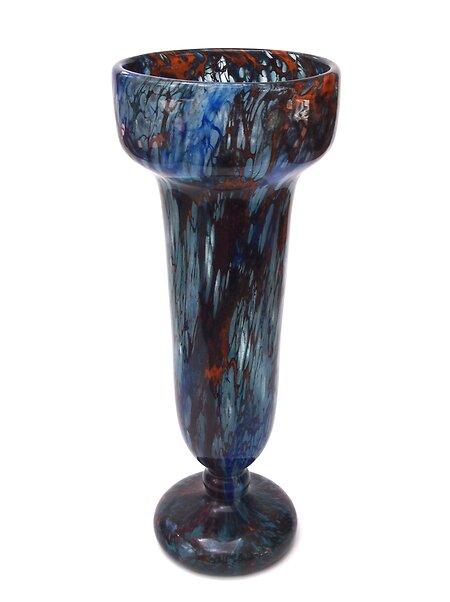
Loetz was a major bohemian glass house in the all powerful Austro-Hungarian empire in the late 1800s and like many major glass houses, they searched high and low for a new look for their glass for the new century. Loetz noted both the potential of the amazing iridised glass being made by Louis Tiffany and the amazing shapes and forms being favoured by the new European Art Nouveau movement. They managed to combine these two styles to magnificent effect. They produced a very wide selection of iridised finishes and organic shaped Art Nouveau glass, becoming highly acclaimed and very successful. They generated over 50 new finishes in only about 5 years. However in the years coming up to the First World War they realised that this lucrative fantasy art nouveau style was clearly going out of fashion and they had to change their style. They took a classic approach, common to the great glass houses; they looked to the great designers at the time and let them design the future. Quite how this worked was unique as this approach ranged from Loetz commissioning major designers to make glass that Loetz could then sell, to the great designers commissioning Loetz to make their designs for the designers to sell themselves. As with France there was a considerable number fashion changes in ‘between the wars’ glass, Loetz tried hard to keep up with the thirst for new looks. They even went back and revived their nouveau styles in an early attempt at ‘retro nouveau’. In the 1920s the significant advancement in techniques meant Loetz actually managed to produce some of the greatest looking ‘Art Nouveau’ glass 10-120 years after it had gone out of fashion. Alas as with so many great glass makers, in the aftermath of the Wall Street crash and the American (a key market for Loetz) Depression, the last Loetz factory closed in the 1930s.

Kralik and Rindskopf were two other entrepreneurial bohemian glass houses in the late 1800s, they both saw what Loetz was doing and decided to follow their style. Unlike many other occasions when companies jumped on the bandwagon to copy a ‘leader’s style, they were still seriously creative. Kralik and Rindskopf went through a brief period of amazing innovation producing, along with Loetz, a body of Jugendstil glass that is almost unique in the history of glass. Amazing shapes, finishes, designs and forms were created, all the skills of glass makers were stretched to the limit. This was the last period where factories were dependent on the dexterity and fine skills of their master glass makers. It’s not a coincidence that this is the last time factory produced glass was often literally covered in the hand used tool marks of the glass makers - later on machines would do this work. This was the end of an era and it went out to great effect.

Interestingly the only time since then that such styles and innovation has been seen in glass is in the recent British movement of small art glass studio makers in the last 10-15 years.

The market for this type of glass has been equally dramatic, 20 years ago the mantra was ‘if it’s Loetz it’s expensive’ any other glass was considered unimportant. However quite recently diligent researchers managed to discover that much of the finest looking ‘Loetz’ glass, from that period, commanding major prices wasn’t Loetz at all. It was in fact Kralik or Rindskopf, or a small number of other such makers. Prices of Loetz and Loetz look-alikes dropped and there was some considerable confusion in the market. Today things have settled down and Loetz remains very collectable, but it has never reached the heights of its peak. Meanwhile the finest pieces of Kralik and Rindskopf are still very affordable and really beginning to seriously take off.

We have available a very wide range or art nouveau Loetz, Kralik, and Rindskopf. Click Loetz, Kralik and Rindskopf to see what we have available from each of these fine makers.


art deco glass #12

Other Great Glass Makers - British

(Best reference: British Glass between the wars Edited by Roger Dodsworth).

We have an extensive collection of rare British enamel glass form Stuart and Webb Corbett; click Stuart and Webb Corbett Enamelware

We have also art nouveau and art deco glass from major British makers such as Stuart, and Jobling and the smaller but important art glass makers Grey-Stan, & Monart. Click Monart & Other British Glass to see what we have on show currently.


art deco glass #13

WMF Ikora

(Best reference: ‘WMF Ikora & Myra Glass’ by Carlo Burschel & Heinz Scheiffele (German & English Language))

Legend has it that WMF (Wurttembergische Metallwarenfabrik) started their glass department, because a company accountant noticed that their glass liner maker was over charging for his work. Being the greatest metalwork factory in Germany and possibly the world, they did not hire just any glass makers they hired the best. After a few years of making liners the glass workers went to the management with an ultimatum: either you let us make our own glass or we all leave.

They started by imitating L C Tiffany and Loetz and produced art nouveau style 'Myra' glass and then one fateful day their chief designer, Karl Weidmann, trying desperately to save a new look piece of Myra preserved the look in an extra layer of glass and the art deco 'Ikora' glass was born.

Ikora was produced from 1928 until the early fifties. It is not unlike the jades of Daum, but includes more random bubbles. There are common pieces of Ikora (usually with brown fronds) and unique pieces. WMF Ikora glass is never signed, sometimes original labels remain and the metal parts of lamps are usually signed.

Until the book; Carlo Burschel & Heinz Scheiffele came out, WMF Ikora was little more than an interesting oddity in the art glass collecting world. The book has now shown what an incredible and innovate range they produced. Prices have already started to rocket in Germany and the rest of Europe too. The most interesting early pieces are in very short supply and we are confident the prices have a long way to go.

We specialise in vases, bowls and lamps by WMF Ikora, especially the older and more unusual pieces. To see our selection of WMF Ikora Glass use the menu at the top left or click WMF Ikora.


art deco glass #14

Tiffany Favrile

(Best reference: ‘Louis C. Tiffany Glass-Bronzes-Lamps’ by Robert Koch)

Louis Comfort Tiffany was the son of the founder of the famed Fifth Avenue Tiffany and Company. He worked there from the 1880s until his death in 1933. He was he first person to produce high quality iridised decorative glassware. He is perhaps most famous for his lamps, but alas the few remaining ones reside only in museums and the houses of the rich and famous. Tiffany called his art nouveau glass 'Favrile' (an Americanisation of the German 'fabrile' meaning hand-made). He also made a wide range of bronze desk pieces, lamps and even ceramic items.

Tiffany Favrile Glass was produced between 1892 and 1928. Pieces are usually signed (often just 'L.C.T.' or 'L C Tiffany Favrile' and sometimes with individual numbers). L C Tiffany desk items were made between 1898 and 1918. They are almost always signed 'Tiffany Studios New York' with either an individual or catalogue number.

Tiffany favrile remains one of the great art glass collectables. We specialise in small favrile glass pieces and individual bronze desk items. To see our selection of L C Tiffany Glass and Bronze use the menu at the top left or click L C Tiffany.


art deco glass #15

Other Great Glass Makers

(Best reference: Glas Der Moderne 1880-1930, Kunstgewerbemuseum Berlin Edited by Ars Nicolai.

We have some Art Nouveau glass & Art Deco glass from bohemia Pallme Koenig, Harrach, Poschinger, and Haida. Slightly further a field we have Fritz Heckert, Arsall and Thereseinthal, from Germany. Also Copier for Leerdam in Holland, and VEDAR from Italy. click Other Decorative Glass to see what we have available.


email: manddmoir@aol.com Phone 07843 022591 Updated: 8/2/2010
© M & D Moir :: powered by WebStall